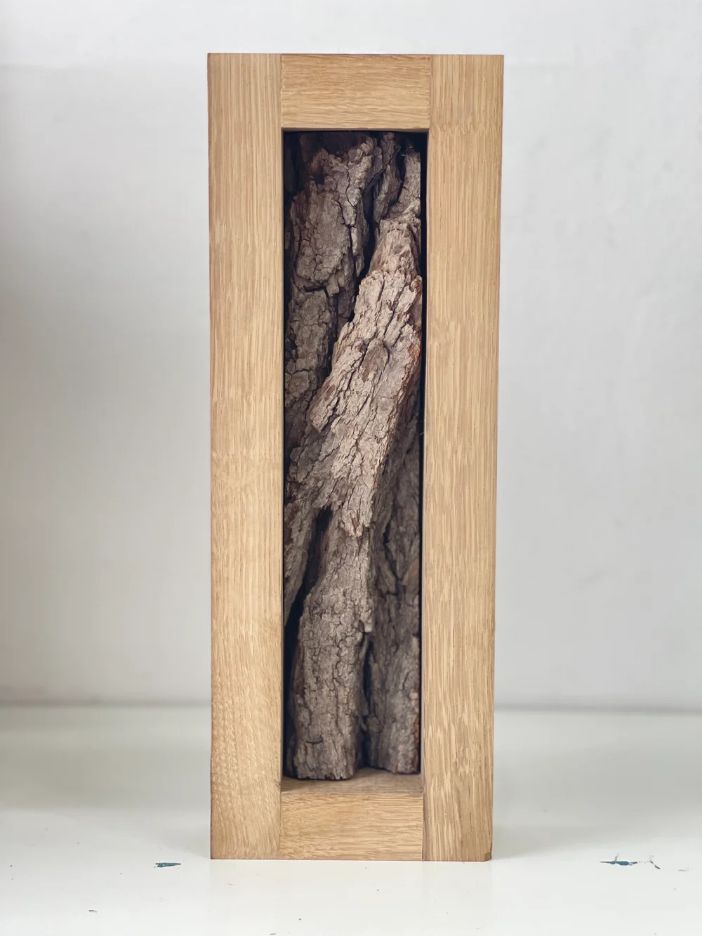
Tobak Gábor: Cím nélkül XVI/VIII
Few people respect wood as deeply as Tobak. His work gives material form to the relationship between people and trees. A member of the KOMOREBI group, he introduced his work in the group exhibition Wabi-sabi — The Perfection of Imperfection; Respect for Wood was his first solo exhibition. His pieces have an elemental effect on viewers. Few works shown at our gallery inspire such a strong urge to touch them. Tobak does not call himself an artist. His first series, made twenty years earlier, used old wooden ceiling beams discovered when a cellar in the Balaton Uplands was dismantled. Gábor works the material himself. The oak frames came from decayed wooden tubs at their house in Csicsó, and he used two kinds of timber for these works. For work no. VIII, Tobak spent more than six months searching for old trees that had fallen or been felled. What I love about the part of the 2023 series made from dead trees — with its thoroughly postmodern resonance — is the way it commemorates nature. These trees no longer provide shade: in 2022–2023, living organisms became material. Through Tobak’s work, their memory continues in our homes as a warm, reassuring object. The artist, known for his modesty, came to his own opening for only fifteen minutes, insisting that we should not make a fuss over him. His work frames this awareness and the beauty of impermanence. The gallery is particularly proud that, after more than ten years, we persuaded Tobak to create a new series. Oak frame.
Méret: 33×12 cm
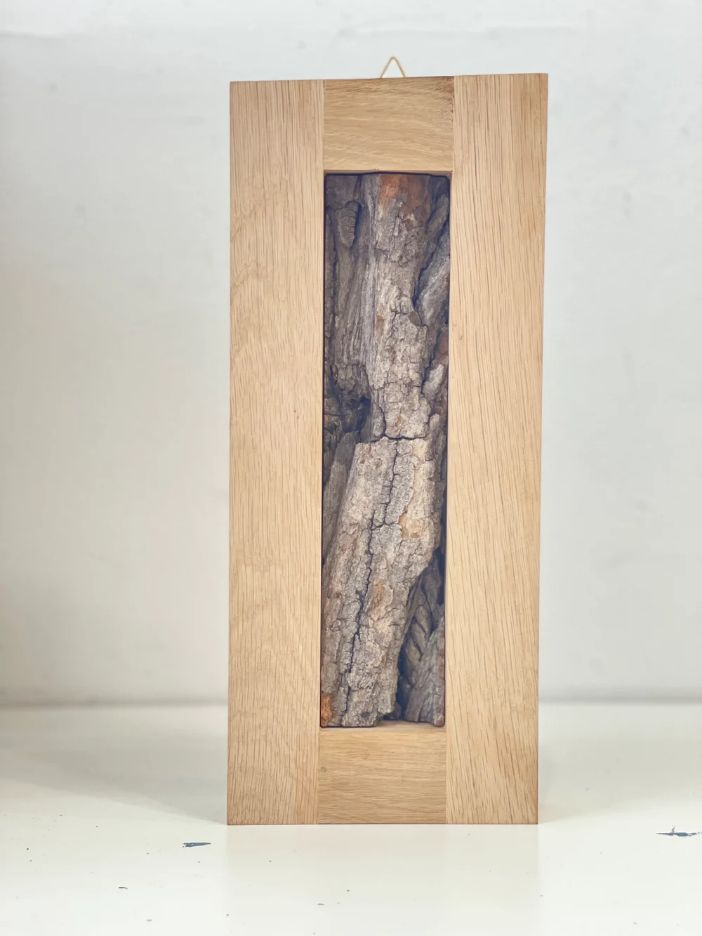
Tobak Gábor: Cím nélkül XVI/IX
Few people respect wood as deeply as Tobak. His work gives material form to the relationship between people and trees. A member of the KOMOREBI group, he introduced his work in the group exhibition Wabi-sabi — The Perfection of Imperfection; Respect for Wood was his first solo exhibition. His pieces have an elemental effect on viewers. Few works shown at our gallery inspire such a strong urge to touch them. Tobak does not call himself an artist. His first series, made twenty years earlier, used old wooden ceiling beams discovered when a cellar in the Balaton Uplands was dismantled. Gábor works the material himself. The oak frames came from decayed wooden tubs at their house in Csicsó, and he used two kinds of timber for these works. For work no. IX, Tobak spent more than six months searching for old trees that had fallen or been felled. What I love about the part of the 2023 series made from dead trees — with its thoroughly postmodern resonance — is the way it commemorates nature. These trees no longer provide shade: in 2022–2023, living organisms became material. Through Tobak’s work, their memory continues in our homes as a warm, reassuring object. The artist, known for his modesty, came to his own opening for only fifteen minutes, insisting that we should not make a fuss over him. His work frames this awareness and the beauty of impermanence. The gallery is particularly proud that, after more than ten years, we persuaded Tobak to create a new series. Oak frame.
Méret: cc 30×13 cm
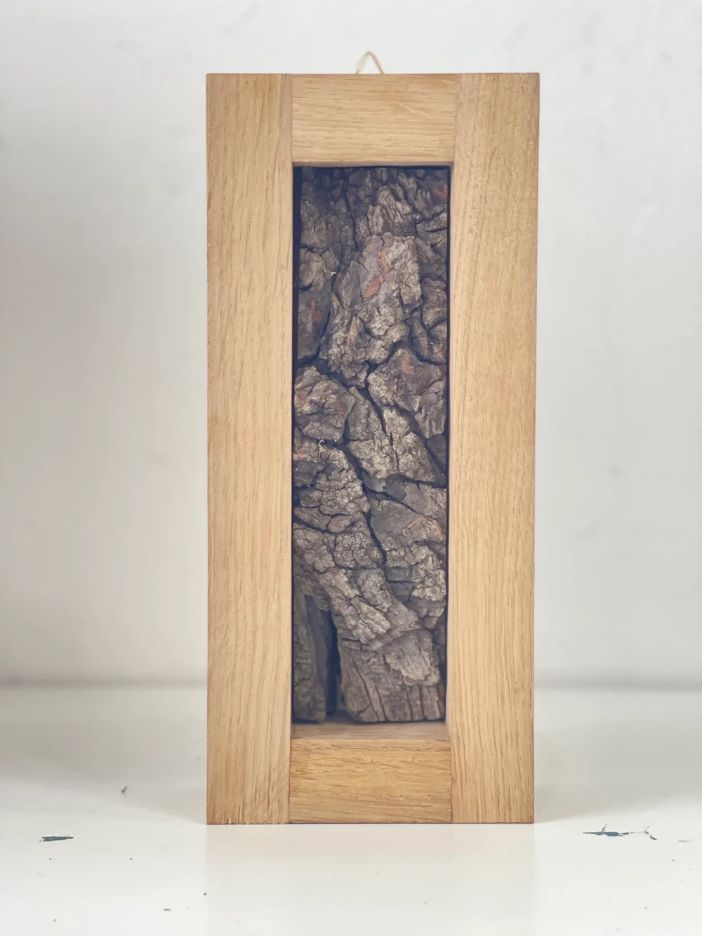
Tobak Gábor: Cím nélkül XVI/X
Few people respect wood as deeply as Tobak. His work gives material form to the relationship between people and trees. A member of the KOMOREBI group, he introduced his work in the group exhibition Wabi-sabi — The Perfection of Imperfection; Respect for Wood was his first solo exhibition. His pieces have an elemental effect on viewers. Few works shown at our gallery inspire such a strong urge to touch them. Tobak does not call himself an artist. His first series, made twenty years earlier, used old wooden ceiling beams discovered when a cellar in the Balaton Uplands was dismantled. Gábor works the material himself. The oak frames came from decayed wooden tubs at their house in Csicsó, and he used two kinds of timber for these works. For work no. X, Tobak spent more than six months searching for old trees that had fallen or been felled. What I love about the part of the 2023 series made from dead trees — with its thoroughly postmodern resonance — is the way it commemorates nature. These trees no longer provide shade: in 2022–2023, living organisms became material. Through Tobak’s work, their memory continues in our homes as a warm, reassuring object. The artist, known for his modesty, came to his own opening for only fifteen minutes, insisting that we should not make a fuss over him. His work frames this awareness and the beauty of impermanence. The gallery is particularly proud that, after more than ten years, we persuaded Tobak to create a new series. One of the last pieces from the old ceiling timber he had kept for twenty years. Oak frame.
Méret: 26×12 cm
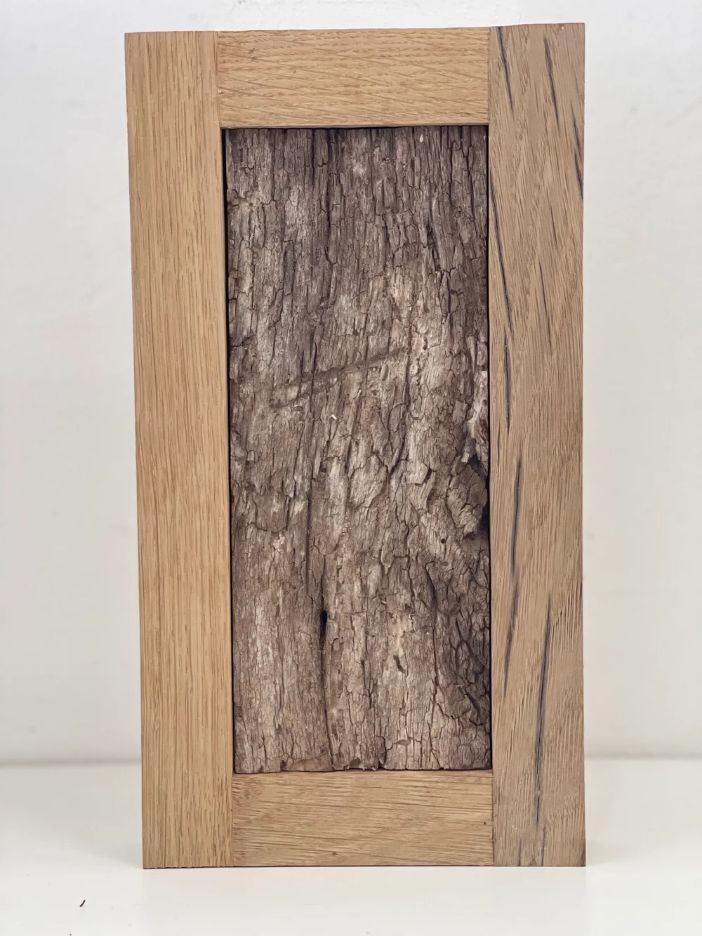
Tobak Gábor: Cím nélkül XVI/XIII (Sebek)
Few people respect wood as deeply as Tobak. His work gives material form to the relationship between people and trees. A member of the KOMOREBI group, he introduced his work in the group exhibition Wabi-sabi — The Perfection of Imperfection; Respect for Wood was his first solo exhibition. His pieces have an elemental effect on viewers. Few works shown at our gallery inspire such a strong urge to touch them. Tobak does not call himself an artist. His first series, made twenty years earlier, used old wooden ceiling beams discovered when a cellar in the Balaton Uplands was dismantled. Gábor works the material himself. The oak frames came from decayed wooden tubs at their house in Csicsó, and he used two kinds of timber for these works. Work no. XIII was made from the original ceiling timber. What does that actually mean? It means that the beauty of this material first prompted him to create. The beauty of time moved him. More than a hundred years ago, someone felled, seasoned and planed the tree, and a craftsman fitted the timber into the cellar. The cellar served for a century; this piece of wood witnessed generations growing up and passing away. It is a tangible reminder of a moment of recognition: the realisation that we are immersed in time. I privately call this work Wounds: healed wounds without which we would not be who we are. The artist, known for his modesty, came to his own opening for only fifteen minutes, insisting that we should not make a fuss over him. His work frames this awareness and the beauty of impermanence. The gallery is particularly proud that, after more than ten years, we persuaded Tobak to create a new series. One of the last pieces from the old ceiling timber he had kept for twenty years. Oak in an oak frame.
Méret: 32×17 cm
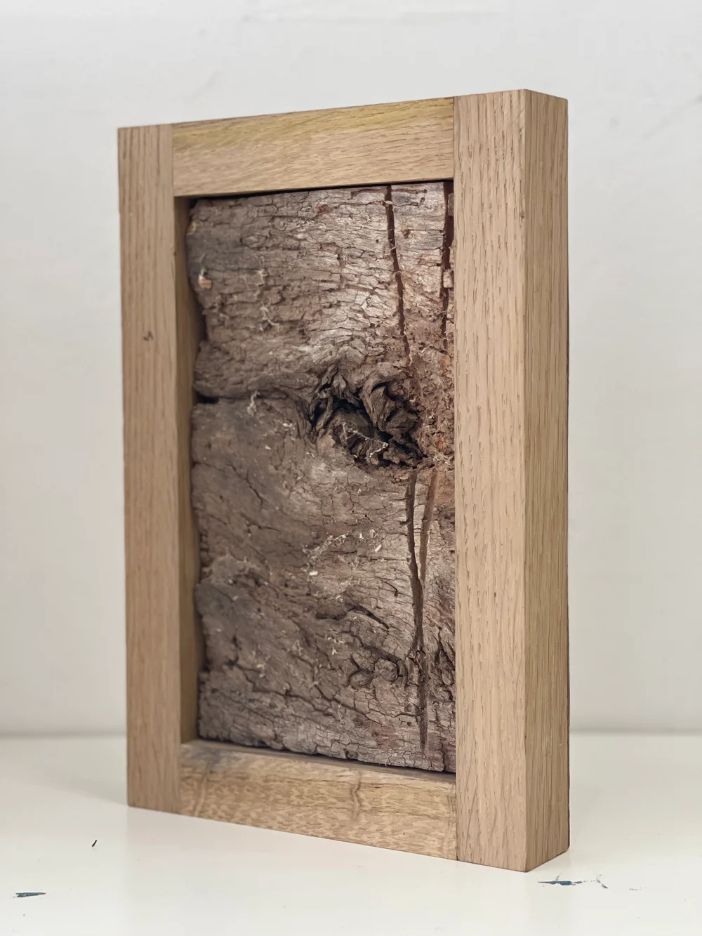
Tobak Gábor: Cím nélkül XVI/XV – Ecce Homo
Few people respect wood as deeply as Tobak. His work gives material form to the relationship between people and trees. A member of the KOMOREBI group, he introduced his work in the group exhibition Wabi-sabi — The Perfection of Imperfection; Respect for Wood was his first solo exhibition. His pieces have an elemental effect on viewers. Few works shown at our gallery inspire such a strong urge to touch them. Tobak does not call himself an artist. His first series, made twenty years earlier, used old wooden ceiling beams discovered when a cellar in the Balaton Uplands was dismantled. Gábor works the material himself. The oak frames came from decayed wooden tubs at their house in Csicsó, and he used two kinds of timber for these works. Work no. XV was made from the original ceiling timber. What does that actually mean? It means that the beauty of this material first prompted him to create. The beauty of time moved him. More than a hundred years ago, someone felled, seasoned and planed the tree, and a craftsman fitted the timber into the cellar. The cellar served for a century; this piece of wood witnessed generations growing up and passing away. It is a tangible reminder of a moment of recognition: the realisation that we are immersed in time. I privately call this work Ecce Homo: the beauty of an anonymous craftsman’s imperfections. The artist, known for his modesty, came to his own opening for only fifteen minutes, insisting that we should not make a fuss over him. His work frames this awareness and the beauty of impermanence. The gallery is particularly proud that, after more than ten years, we persuaded Tobak to create a new series. One of the last pieces from the old ceiling timber he had kept for twenty years. Oak in an oak frame.
Méret: 29×19 cm
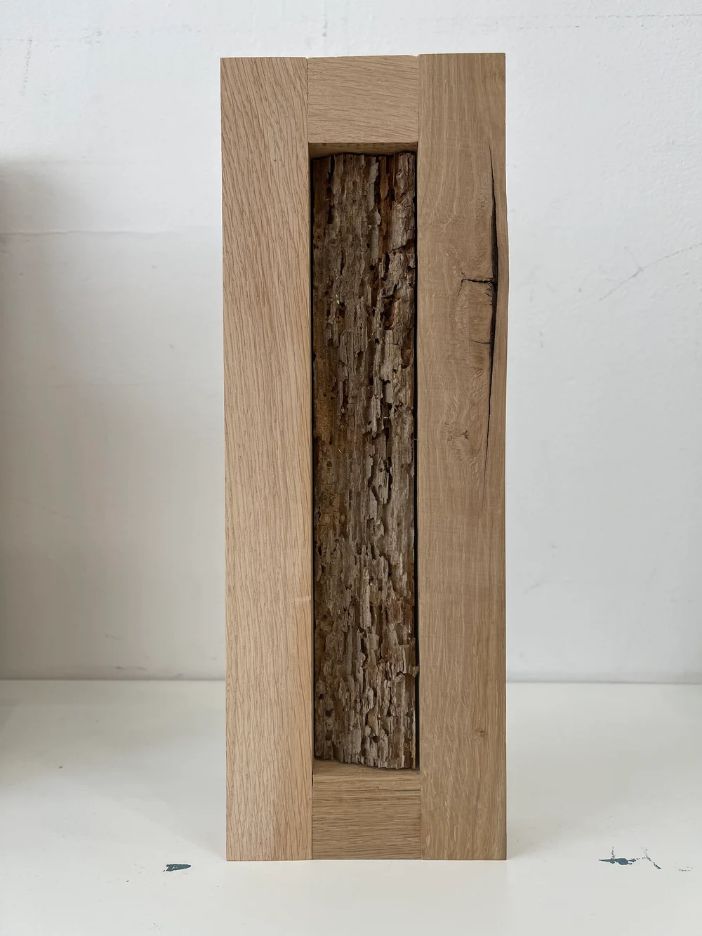
Tobak Gábor: Cím nélkül XVI/XVI
Few people respect wood as deeply as Tobak. His work gives material form to the relationship between people and trees. A member of the KOMOREBI group, he introduced his work in the group exhibition Wabi-sabi — The Perfection of Imperfection; Respect for Wood was his first solo exhibition. His pieces have an elemental effect on viewers. Few works shown at our gallery inspire such a strong urge to touch them. Tobak does not call himself an artist. His first series, made twenty years earlier, used old wooden ceiling beams discovered when a cellar in the Balaton Uplands was dismantled. Gábor works the material himself. The oak frames came from decayed wooden tubs at their house in Csicsó, and he used two kinds of timber for these works. Work no. XVI was made from the original ceiling timber. What does that actually mean? It means that the beauty of this material first prompted him to create. The beauty of time moved him. More than a hundred years ago, someone felled, seasoned and planed the tree, and a craftsman fitted the timber into the cellar. The cellar served for a century; this piece of wood witnessed generations growing up and passing away. It is a tangible reminder of a moment of recognition: the realisation that we are immersed in time. The artist, known for his modesty, came to his own opening for only fifteen minutes, insisting that we should not make a fuss over him. His work frames this awareness and the beauty of impermanence. The gallery is particularly proud that, after more than ten years, we persuaded Tobak to create a new series. One of the last pieces from the old ceiling timber he had kept for twenty years. Oak in an oak frame.
Méret: 35×12 cm