Painting and Me
From Kindergarten to the Pandemic
For me, painting has always had a diary-like role. Its beginnings perhaps go all the way back to my early childhood, when I was not very talkative. “What happened at kindergarten today?” “Nothing.” But I would draw the events of the day.
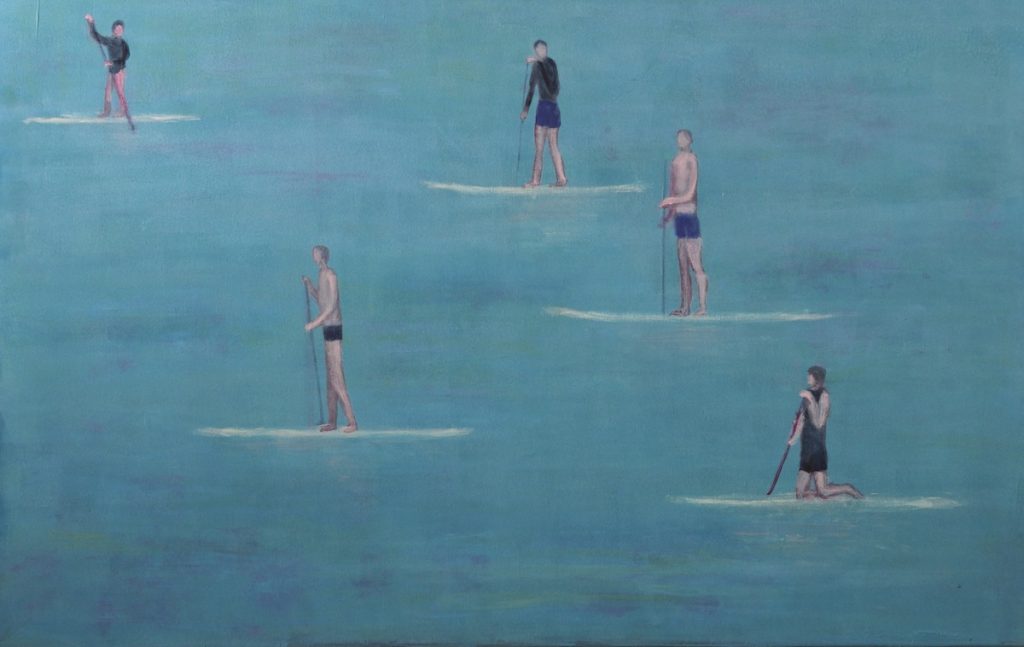
I kept drawing for quite a long time, although I was never able to draw well — and I still cannot.
My first attempts at painting began at least 20–25 years ago, though back then only occasionally. Over the past ten years, I have been painting more and more often. The practice became more regular mainly because the process itself began to generate its own momentum, and partly because my circumstances also became more favourable: a small separate room in the attic, and a little more time.
The great breakthrough came with the pandemic, when I was finally able to devote my newly available time to painting. Of course, plans and ideas had already been forming during the more “passive” periods as well — and new ones continue to emerge even now, constantly.

For me, painting itself often looks like this: I simply linger in front of a half-finished or completed painting, or in front of an empty surface. I am not thinking in the strict sense of the word, but I am thinking — looking, observing, waiting.
So I am not always painting when I paint, but I am also painting when I am not painting.
Usually, my mind is occupied with what should be painted, and how. Almost any experience or visual impression makes me wonder what kind of painting could come out of it. These experiences do not have to be extraordinary at all. I am most inspired by my immediate surroundings and by everyday events — things that could happen to any of us, at any time.
In this sense, the source of my subjects seems inexhaustible.

I have not formally studied painting or drawing; I gain experience through practice. When I encounter a particular technical problem, I look it up in books or on the internet, and otherwise I look at other people’s paintings — or more precisely, I devour them.
I pursued visual studies for a relatively long time through the Kontakt photography courses. There, the teaching went far beyond the technical aspects of photography: it offered a way of seeing, a kind of visual literacy. I suspect that more of this stayed with me than the technical knowledge itself.

Incidentally, it was during a more in-depth Photoshop course that the thought occurred to me: well, why not paint instead?
I have not owned a professional camera for a long time. The most serious photographic task I face is photographing my own paintings, which, without proper studio conditions, can often be quite a difficult challenge. Otherwise, I almost exclusively take photographs with my phone, and a significant number of these images are made as sketches for future paintings.
From time to time, I think that it might be worth learning painting formally as well, but I never quite bring myself to do it. Not only because, in my limited free time, I would rather paint than attend a course, but also because painting gives me the freedom to figure things out for myself, to experiment, to make mistakes, to distance myself somewhat from rules — and even to allow myself not to know the rules very well, and to stand outside stylistic movements.
Looking back at my earlier works, I increasingly appreciate the awkwardness in them — something I still try not to lose, even now that I paint with more experience. In this sense, I consider myself a naïve painter.
Recently, as a kind of style has begun to take shape, together with the main themes that occupy me, I have started to think more in terms of series — or at least in images that belong together, in pairs or groups.

My day job, the one I make a living from, is nowhere near as creative. In fact, it consists almost entirely of knowing and applying rules. Yet these two areas of my life complement each other quite well. Although, of course, if I could make a living from painting…
Besides the fact that my subjects and inspirations come from the most ordinary visual impressions, I am also a great consumer of images. I even enjoy looking at my acquaintances’ holiday photos. Some of my paintings have been based on images like these as well.
Naturally, the list of artists whose works I admire — and who influence my own paintings either directly or indirectly — is a long one. And it is not only long, but also mixed: I like the works of many painters whose style is very far from my own. This broad field includes many different movements and approaches, from naïve painters to Post-Impressionism, from Bad Painting to Abstract Expressionism.
In photography, subjective documentary photography and street photography are closest to me, although I also enjoy staged photographs.
Thanks to the internet and social media, I have been able to discover many artists who are not famous — or at least whom I had never heard of before — yet whose visual world feels very close to mine. And there are probably many artists whose works have influenced me without my even remembering them specifically, though at some point they shaped the way I see.
If I absolutely had to single out a few names, without aiming to be exhaustive:
Painting:
cave paintings;
the Bayeux Tapestry — all right, not only paintings 🙂
Henri Rousseau;
Niko Pirosmani;
Paul Gauguin;
Chaïm Soutine;
Alberto Morrocco;
David Hockney and the painters of the School of London;
Gerhard Richter;
Peter Doig;
many painters previously completely unknown to me, whom I discovered through social media, such as Jessie Homer French and Katherine Bradford;
Among contemporary Hungarian painters, the works and encouraging words of Gábor Király, Balázs Fischer, József Csató, and Tibor Nádor continue to push me forward, and Imre Bukta has certainly had an influence on me as well.
Photography:
Martin Parr;
Vivian Maier;
Stephen Shore;
the gems of Fortepan.